


| SAILMAKING and SAILMAKERS |
| Pictures with YELLOW boxes are clickable to produce a larger picture: with WHITE boxes are full-sized already. |
While I'm not a COMPLETE tyro at working canvas, I am by no means an expert at the craft like Louie Bartos . I can manage a seam
without sewing the canvas to my leg (usually!) but when it comes to complicated or intricate designs, I stand back and let the pros
take over. This page is for those who have some interest in the art.
without sewing the canvas to my leg (usually!) but when it comes to complicated or intricate designs, I stand back and let the pros
take over. This page is for those who have some interest in the art.


If you've been paying attention (and have visited a few other pages
here) you've seen Del (Tim) Timmerman's name before... He's a
fur-trade re-enactor and outdoorsman from Iowa and he makes
seabags and hammocks appropriate to that era in the traditional
style. Here we can see one of his eyelet grommets, hand sewn
around a bronze ring (1) and the grommets in use on a seabag
with a diamond knot tied in the lanyard. (2)
here) you've seen Del (Tim) Timmerman's name before... He's a
fur-trade re-enactor and outdoorsman from Iowa and he makes
seabags and hammocks appropriate to that era in the traditional
style. Here we can see one of his eyelet grommets, hand sewn
around a bronze ring (1) and the grommets in use on a seabag
with a diamond knot tied in the lanyard. (2)


The Ditty Bag. Possibly the most idiosyncratic item owned by any sailor was his
ditty-bag. He stored his tools, his pipe, tobacco, clothing... If it wasn't in his
seachest, it was in his ditty-bag and consequently they became examples of a
sailor's ability to sew and decorate canvas. This one was made by "Clyderigged"
(Jamie White) while crewing on the reproduction of The Bounty during the filming of
the movie with Mel Gibson. It is constructed of #10 canvas (fairly heavy stuff) with a
leather bottom and top-and-bottom grommeting, sewn eyelets, thimbled cringles and
some wonderful work on the lanyard itself. (See his KNIFE set HERE)
ditty-bag. He stored his tools, his pipe, tobacco, clothing... If it wasn't in his
seachest, it was in his ditty-bag and consequently they became examples of a
sailor's ability to sew and decorate canvas. This one was made by "Clyderigged"
(Jamie White) while crewing on the reproduction of The Bounty during the filming of
the movie with Mel Gibson. It is constructed of #10 canvas (fairly heavy stuff) with a
leather bottom and top-and-bottom grommeting, sewn eyelets, thimbled cringles and
some wonderful work on the lanyard itself. (See his KNIFE set HERE)
(1) full view of the bag; (2) the bag hanging up; (3) an annotated view of the lanyard assembly.... Quite an undertaking; (4) (full size as shewn)
Clyderigged's "shellback" date and longitude where he crossed the equator, along with a commemorative pewter button from the voyage; (5) a view
of the bag and the decorative drawn-work around the top and (6) the leather bottom with the bottom grommet. If this bag were any bloody saltier,
you could sail on it. I am DEFINITELY making one!
Clyderigged's "shellback" date and longitude where he crossed the equator, along with a commemorative pewter button from the voyage; (5) a view
of the bag and the decorative drawn-work around the top and (6) the leather bottom with the bottom grommet. If this bag were any bloody saltier,
you could sail on it. I am DEFINITELY making one!

Sailmaker's "Scorpion" style
bench-hook (antique)
The nose of the hook is run on a
grinder or filed to produce a
shoulder which prevents the hook
from completely entering the
canvas and opening a potentially
ruinous hole.... The bench-hook's
use can be seen in the print to left.
bench-hook (antique)
The nose of the hook is run on a
grinder or filed to produce a
shoulder which prevents the hook
from completely entering the
canvas and opening a potentially
ruinous hole.... The bench-hook's
use can be seen in the print to left.

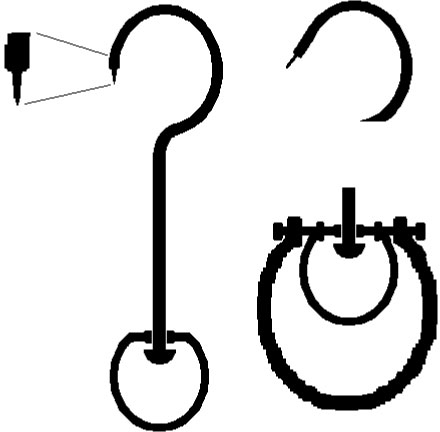
| Single bail is to make up to your lanyard, twin bail allows a 'handy-billy' to tension footropes. |

Couple months back, I got into a long email 'discussion' with a gent who was completely opposed to "doing things the 'old
way' when so many great modern improvements were available", one of which (he opined loudly) is the brass-plated 'spur'
grommet. Well, he didn't convince me then and I don't think anyone else is gonna convince me in the future: for bags and
tarpaulins not subjected to great stresses, the "spur" grommet is adequate and a lot faster than sewing rings, but for sails,
sewn rings and collars are "da bom!" A spur grommet is fine for an EMERGENCY ONLY. I'd no sooner trust one than I'd
trust A Certain Un-Elected Official. (Hell, I'd trust the grommet BEFORE I'd trust THAT (censored)... But I digress.)
(1) shews an illustration of the types of metal grommets: ring and collar (the best) and the spur grommet, as well as a "bow"
hole cutter(larger holes) , grommet setting die and punch and "single" hole cutter (smaller holes). (Cutting on a sheet of lead
or linoleum is the best way to do it!)
The problem with the "spur" type is that one is never sure if the grommet is seated properly: too little force on the setting
stroke will produce a loose grommet and too much will cause the grommet edges to cut into the cloth: both lead to
premature failure. Also, positioning them is somewhat chancey for optimum holding.
Sewing a ring into the sail and then setting a brass collar grommet is more precise, as you can gauge the correct setting of
the collar... Again, too much force tends to cut the twine stitching the ring to the hole, but too little will be readily apparent
because the grommet will be loose. However, try finding the brass collar grommets.... They are available, but fewer and
fewer manufacturers make them as time passes.
In the event you CAN'T locate any, then (2) is a viable alternative to the problem: nested rings. MUCH trickier to do than a
ring and collar installation, but just as strong and usable.
But my final argument on sewing rings is provided by (3): a picture from Mariner Sails' website (Louie Bartos). Louie is a
respected sailmaker in Alaska and a pro: his business is to turn out the best job as fast as possible. If it's worth his time
to sew 'em in and leather the chafe points, then that's all the recommendation I need.
way' when so many great modern improvements were available", one of which (he opined loudly) is the brass-plated 'spur'
grommet. Well, he didn't convince me then and I don't think anyone else is gonna convince me in the future: for bags and
tarpaulins not subjected to great stresses, the "spur" grommet is adequate and a lot faster than sewing rings, but for sails,
sewn rings and collars are "da bom!" A spur grommet is fine for an EMERGENCY ONLY. I'd no sooner trust one than I'd
trust A Certain Un-Elected Official. (Hell, I'd trust the grommet BEFORE I'd trust THAT (censored)... But I digress.)
(1) shews an illustration of the types of metal grommets: ring and collar (the best) and the spur grommet, as well as a "bow"
hole cutter(larger holes) , grommet setting die and punch and "single" hole cutter (smaller holes). (Cutting on a sheet of lead
or linoleum is the best way to do it!)
The problem with the "spur" type is that one is never sure if the grommet is seated properly: too little force on the setting
stroke will produce a loose grommet and too much will cause the grommet edges to cut into the cloth: both lead to
premature failure. Also, positioning them is somewhat chancey for optimum holding.
Sewing a ring into the sail and then setting a brass collar grommet is more precise, as you can gauge the correct setting of
the collar... Again, too much force tends to cut the twine stitching the ring to the hole, but too little will be readily apparent
because the grommet will be loose. However, try finding the brass collar grommets.... They are available, but fewer and
fewer manufacturers make them as time passes.
In the event you CAN'T locate any, then (2) is a viable alternative to the problem: nested rings. MUCH trickier to do than a
ring and collar installation, but just as strong and usable.
But my final argument on sewing rings is provided by (3): a picture from Mariner Sails' website (Louie Bartos). Louie is a
respected sailmaker in Alaska and a pro: his business is to turn out the best job as fast as possible. If it's worth his time
to sew 'em in and leather the chafe points, then that's all the recommendation I need.


Two woodcuts from Eddie Climo in England... They look to be about ca. 1815 or so. The first shews two sailmakers on a communal bench roping
in a sail... I'm not just sure WHAT 'baldy' is about. The second shews sailors serving what looks to be a main backstay or perhaps an anchor
cable, but a close study of the large version will leave you wondering just what they're about...in both cases the artist was probably not a seaman
and got the process about 80% right. Still, they're interesting to study.
in a sail... I'm not just sure WHAT 'baldy' is about. The second shews sailors serving what looks to be a main backstay or perhaps an anchor
cable, but a close study of the large version will leave you wondering just what they're about...in both cases the artist was probably not a seaman
and got the process about 80% right. Still, they're interesting to study.


A sailmaker's seam-rubber of Lignum Vitae (Live Oak), used for creasing down seams prior to sewing (getting them flat and aligned to ensure a
smooth, straight seam) and then used for "rubbing over" the stitching once sewing is completed. This one is probably from ca. 1900, by McIlhenny
Bros from the Grimsby, Humberside area of England's east coast. There is an imprint but it's almost indecipherable, as well as a Broad Arrow
faintly seen between the imprint's lines, indicating it was made for the Royal Navy as an "issue item". The plain bound haft would seem to bear
this out. Whatever, it's a great rubber and fits my hand just right. Even after a hundred years, the Lignum Vitae still feels like it's been oiled
recently. Wonderful wood, that.
smooth, straight seam) and then used for "rubbing over" the stitching once sewing is completed. This one is probably from ca. 1900, by McIlhenny
Bros from the Grimsby, Humberside area of England's east coast. There is an imprint but it's almost indecipherable, as well as a Broad Arrow
faintly seen between the imprint's lines, indicating it was made for the Royal Navy as an "issue item". The plain bound haft would seem to bear
this out. Whatever, it's a great rubber and fits my hand just right. Even after a hundred years, the Lignum Vitae still feels like it's been oiled
recently. Wonderful wood, that.
| ~~~~~~~~~~~~~~~~~~~~~~~~~~~~~~~~~~~~~~~~~~~~~~~~~~~~~~~~~~~~~~~~~~ |

Ron Payne has also sent in an
excellent example of what an artist in
wrought iron can do with a bare
description to work from: his
sailhook is eminently suited for
working on mainsails and larger
canvas projects and features a true
stepped scorpion tip (all it needs is to
be filed to the dimension/sharpness
desired by the sailmaker) with a
strong shoulder feature to prevent
tear-through. The large bail is
designed for using 1/2 manila and a
handy-billy or luff-tackle to "proof" a
sail (put it under tension in the loft to
see if there are any problems before
use on the ship) or for roping the foot
and or leach of the sails. It'll also
quieten up the drunks around the
dock, I'll warrant!
excellent example of what an artist in
wrought iron can do with a bare
description to work from: his
sailhook is eminently suited for
working on mainsails and larger
canvas projects and features a true
stepped scorpion tip (all it needs is to
be filed to the dimension/sharpness
desired by the sailmaker) with a
strong shoulder feature to prevent
tear-through. The large bail is
designed for using 1/2 manila and a
handy-billy or luff-tackle to "proof" a
sail (put it under tension in the loft to
see if there are any problems before
use on the ship) or for roping the foot
and or leach of the sails. It'll also
quieten up the drunks around the
dock, I'll warrant!


Commercially-available Sailmaker's
"bench-hooks"
The top one is too blunt and the
bottom too sharp.
"bench-hooks"
The top one is too blunt and the
bottom too sharp.
A Sailmaker's loft in Maine 1885- (Note the
hanging stove so canvas can be laid out
underneath it!)
hanging stove so canvas can be laid out
underneath it!)
| ~~~~~~~~~~~~~~~~~~~~~~~~~~~~~~~~~~~~~~~~~~~~~~~~~~~~~~~~~~~~~~~~~~ |
| ~~~~~~~~~~~~~~~~~~~~~~~~~~~~~~~~~~~~~~~~~~~~~~~~~~~~~~~~~~~~~~~~~~ |
Up in the ditty bag section, I referred to "cringles", which are basically grommets formed around
something and acting as an "ear" or "gripe" where you may make a line fast for whatever purpose. If
you obtain a copy of Frank Rosenow's "Ditty Bag Book" or Emiliano Marinero's "Sailmaker's
Apprentice", you'll find ways of making them, but one problem has always been getting the thimble (the
round brass insert) into the little buggers. Usually, this entailed pounding the finished cringle down
onto a floor fid and then trying to get the expanded cringle up off the fid and the thimble inserted before
the cringle shrank back to it's intended size. A trick best performed by two people or someone with
three hands, and fast ones at that!
Well, one of the benefits of being a nosey bugger is that you find things like the Wooden Boat Forum and
people who have some of the neatest ideas on how to do things, to wit: The Cringling Fid. (1) Ain't
that a honey of a solution? Just pound the cringle down ONTO the thimble, then separate the fid halves
and Roberts Yer Mother's Brother!
something and acting as an "ear" or "gripe" where you may make a line fast for whatever purpose. If
you obtain a copy of Frank Rosenow's "Ditty Bag Book" or Emiliano Marinero's "Sailmaker's
Apprentice", you'll find ways of making them, but one problem has always been getting the thimble (the
round brass insert) into the little buggers. Usually, this entailed pounding the finished cringle down
onto a floor fid and then trying to get the expanded cringle up off the fid and the thimble inserted before
the cringle shrank back to it's intended size. A trick best performed by two people or someone with
three hands, and fast ones at that!
Well, one of the benefits of being a nosey bugger is that you find things like the Wooden Boat Forum and
people who have some of the neatest ideas on how to do things, to wit: The Cringling Fid. (1) Ain't
that a honey of a solution? Just pound the cringle down ONTO the thimble, then separate the fid halves
and Roberts Yer Mother's Brother!
| ~~~~~~~~~~~~~~~~~~~~~~~~~~~~~~~~~~~~~~~~~~~~~~~~~~~~~~~~~~~~~~~~~~ |
| 2 |
| 1 |
| ~~~~~~~~~~~~~~~~~~~~~~~~~~~~~~~~~~~~~~~~~~~~~~~~~~~~~~~~~~~~~~~~~~ |
| 1 |
| 2 |
| 3 |
| 4 |
| 5 |
| 6 |
| 1 |
| 1 |
| 1 |
| 1 |
| 2 |
| 3 |
| ~~~~~~~~~~~~~~~~~~~~~~~~~~~~~~~~~~~~~~~~~~~~~~~~~~~~~~~~~~~~~~~~~~ |
| 1 |
| 2 |
| ~~~~~~~~~~~~~~~~~~~~~~~~~~~~~~~~~~~~~~~~~~~~~~~~~~~~~~~~~~~~~~~~~~ |
| 1 |
Chris Collins of New Hampshire (whom I have sufficiently maligned on the TOOLS page) sent me these wonderful wrought-iron
Scorpion-tipped sailhooks the other day and I've been playing with them ever since! (The grid is 1/2") They are superbly well-formed and would be
a credit to any sailmaker's ditty-bag, not to mention being about 500% better than their commercially- available brethren shewn above! I'm
prejudiced... ANYthing handmade is aces in my journal over a mass-manufactured item, but these surpass even my snooty tastes. My very great
thanks to him for his kindness!
Scorpion-tipped sailhooks the other day and I've been playing with them ever since! (The grid is 1/2") They are superbly well-formed and would be
a credit to any sailmaker's ditty-bag, not to mention being about 500% better than their commercially- available brethren shewn above! I'm
prejudiced... ANYthing handmade is aces in my journal over a mass-manufactured item, but these surpass even my snooty tastes. My very great
thanks to him for his kindness!
| ~~~~~~~~~~~~~~~~~~~~~~~~~~~~~~~~~~~~~~~~~~~~~~~~~~~~~~~~~~~~~~~~~~ |


| Jamie is a professional ships rigger and most recently rigged all the ships for the Pirates of the Caribbean movies! |
| ~~~~~~~~~~~~~~~~~~~~~~~~~~~~~~~~~~~~~~~~~~~~~~~~~~~~~~~~~~~~~~~~~~ |
Want to learn how to make either a ditty-bag or a seabag in
the traditional manner? My good friend and
Master-sailmaker, Louis Bartos of Mariner Sails in Ketchikan,
Alaska, is now ready to ship his illustrated monograph on
how to do so, not only traditionally, but correctly! Louie has
been working on this for several years and the proof copy I've
seen is informative, easily understood and will be a REAL
addition to anyone's "under-weigh" library.
Don't miss out on this: It will be a limited-run print. Price is
$22.60 USD in the US and Canada and worth every penny.
Contact him HERE at his website page.
Louie is also working on a new booklet which will teach the
correct method of making both the traditional wood-bottomed
ship's canvas bucket as well as the canvas-bottomed type.
This is how buckets were made aboard sailing ships in the
old days... Canvas and wood, with a grommet top and a
spliced hemp becket handle. They were reliable, quiet, not
apt to scar the deck or sides like a metal bucket and
considerably easier to store!
Contact Louie to put in your request for a copy once finished!
I already have!
the traditional manner? My good friend and
Master-sailmaker, Louis Bartos of Mariner Sails in Ketchikan,
Alaska, is now ready to ship his illustrated monograph on
how to do so, not only traditionally, but correctly! Louie has
been working on this for several years and the proof copy I've
seen is informative, easily understood and will be a REAL
addition to anyone's "under-weigh" library.
Don't miss out on this: It will be a limited-run print. Price is
$22.60 USD in the US and Canada and worth every penny.
Contact him HERE at his website page.
Louie is also working on a new booklet which will teach the
correct method of making both the traditional wood-bottomed
ship's canvas bucket as well as the canvas-bottomed type.
This is how buckets were made aboard sailing ships in the
old days... Canvas and wood, with a grommet top and a
spliced hemp becket handle. They were reliable, quiet, not
apt to scar the deck or sides like a metal bucket and
considerably easier to store!
Contact Louie to put in your request for a copy once finished!
I already have!

